Friday, December 9, 2011

Autumn trip to England

At the end of September, early October 2011, Lars and I took a trip to St Albans and London, England.  Lars wanted to visit his former coworkers at Veolia in England, and I wanted to visit England and see the places I had visited everyday last year while briefly living with him.  We first when to St Albans to a pub for lunch.  I had a wonderful time meeting his colleagues and enjoyed putting a face to the name.

The whole time I was in England,  Lars told me that it was inappropriate for him to bring me to meet his colleagues or to accompany him to work social events.  There were lots of events such as Christmas parties and happy hours, but, according to Lars, no one ever took their wife or husband.  This custom is very different than in America, I thought.  At the last place I worked, spouses and kids often dropped by the office, especially on Fridays.  I'm not saying it happened all the time, and some people were more private than others, but I had the impression that being too private was bad for office relationships and caused distrust from your coworkers. And once a year there was a Christmas Party where everyone brought their spouses or partners.  That seems normal to me; why go to a party and not be able to bring your partner?  But Europe is famous for it's separation of private and professional spheres, to whatever good that brings, which is little in my eyes.

ST ALBANS
Lars walking the streets of St Albans on the way to the train station.

I took the above picture because I wanted to capture how narrow the streets are.  Also, to the left you can see half of an outer wall of a building (below) with interesting stonework.  These stones appear all over town in the older buildings dating back to the Georgian era, I believe, or maybe earlier.  I have seen the rocks in walls, in the abbey and in other clergical buildings.  I also think I saw a similar pattern of stone building in the original wall of Cottbus, in Germany, so maybe this goes farther back to medieval building customs.
House built into the stone wall of previous building.


Modest American style row house in Philadelphia.
I liked this picture because it really captures how small these row homes are.  this is much smaller than what I was used to seeing in the northeast of the US in Philadelphia, for example.  Now, this real estate is very expensive.  Did these buildings house just working class tenants/owners?  It is interesting to note the walk-up difference between American and English style row-houses.  In the US, even modest row houses include the standard stoop, which became a cornerstone of street social lounging and chatting.  (See picture to the right from Amer. style.)

 It seems like a better alternative to a suburban single family home or an urban apartment if you, for example, want to save yourself the cost of yard maintenance but still want the personal feeling of walking up to your front door.  I can see myself raising kids in this kind of house much easier than in a single-family home with front and back yards. A small little patio or porch would be enough for me, because I love public parks where someone else does the yard maintanence and where it feels more social. Besides, kids don't like to play by themselves.  I always used to play on the street or in the wooded area on the block-- just like a park!  We didn't play in a closed off back-yard after a certain age, anyway. I know that the funnest games and best forts happened "out there" not "at my house". What the tenant here loses in yard, gains in access to public green space such as parks and nature trails.  That is, as long as you have a smart urban planner and developers and local politicians who can imagine it.
Beautiful blue door.


The above winding street illuminates the clash of modern and "old" England.  I parenthesized "old" because I think that the idea of an older, historical and traditional village plays a big marketing role in St Albans tourism and real estate business.  St Albans is in fact old, though, because it was a Roman trading point and then later a medieval market town.  However, the real roman town is sort of outside of St Albans now, so few of the buildings visible here are probably much older than the last few centuries.  Nonetheless, the sign advertising a car wash seemed a practical, yet somehow contradictory allusion to modern life. 

Another invisible force not shown in this picture is the force of suburbanization of the area outside of London.   Lars and I noticed very quickly that St Albans has some strange quirks.  For example, people working in St Albans usually don't live in St Albans and must commute to it for work.  Most people living in this and similar small towns actually work in London.  A shocking number of men and women living in St Albans are not  in St Albans during the day.  The streets are, however, filled on market days and weekdays with women, children and the elderly, who, presumably live in St Albans. The men are eerily absent.

The inhabitants seem to have a real culture of stay-at-home moms, who shop at the fancy shops and push their babies in prams and pull their children around town while the men work in London.  

Some businesses have completely moved out of London to accommodate the workers living in the suburbs, such as Veolia, which services the entire London area but is not located in London.  Although these villages such as St Albans were once vibrant and economically self-servicing villages in their own right, now most inhabitants cannot afford the real estate prices in St Albans and choose to live in neighboring towns with less charm, where the prices are lower.  Lars moved first to Hatfield in 2010, but decided that the town felt too depressing, so he moved to St Albans.  He paid almost $1000 dollars rent per month just for a bedroom in a house!!  And, he wasn't even living the high life in London; he was living practically in the burbs.

I learned much of this by talking with the owner of the local language school, St Albans School of Languages, Ian, by talking with little old ladies (I mean the term nicely) on the bus and by visiting the local history museum.  I haven't done much outside reading though.

Nonetheless, the below picture highlights the beauty of St Albans.  Notice the very expensive cars parked in front of the Victorian row houses below.  How sad that the original front gardens have been turned into parking lots.

 Lars says that the prices in St Albans are just as high as in London.  Do these Londoners choose to live in St Albans just so they can live in a place with a small town feel?  London already felt small time to me.  I'd like to understand the psychology going on here.


LONDON


The rest of the pictures were taken in London.  The first pictures were taken the following day in the borough of Kensington.  Below, in the center of the picture is Harrod's department store.
Me with Harrods in the background

Bench sill with spikes in front of Barclay's Bank
I took the above picture because I was shocked at the spikes on the window sills.  Now, some people might say the spikes were surely intended to keep the birds off  the ledge.  I wonder though.  That ledge looks suspiciously like a bench, which is not an easy thing to find in England on the streets.  Just when you think you have found a place to sit, someone put spikes on it, so you can't sit.  It seems so obviously aggressive.  I hope it is just to keep the birds at bay, an no one else.
Inside Harrods; chocolate bar


The above picture was taken from within Harrods in the department for food purchases.  I had read that the beginning of the international design philosophy called Art & Crafts, which eventually came to the US and was known on continent, aka Europe, as Art Nouveau, began in England by a man named William Morris.  It was very awe inspiring to look at examples of this design trend in England, where it originated.  Below is a link to information about the design philosophy, which I've mentioned a few times on my blog already.

Arts & Crafts Movement
Candy shopping at Harrods.  
Above and below, notice the beautiful ceiling plaster work and the gold brushed lamps and painted columns.  The picture doesn't do it justice!
Arts & Crafts column with tile work.
Notice the organic shapes painted onto the tiles and incorporated into the plaster.  Arts and Crafts design was a philosophical rejection of the effect of industrialization on workmanship.  Of course the design philosophy first became popular in England, since England was the first country to undergo industrialization and introduce it to the world.

I love how complex countries can be, first creating something and calling it progress, then leading the counter-revolution against it!  I think the US is like this in many ways, and I notice how different the US is in its ideologies from Europe.   For example, like industrialization in England, consumerism in its modern form was practically invented in the US and spread out to the rest of the world. But, more and more, I feel that Americans are searching, sometimes nostalgically, for more meaning in our social, personal and professional lives, and we seek this sort of traditional sense of community that walkable cities and street markets can give us.  I talked about this topic in a the blog about corporate America.  I think the countertrend to this type of consumerism takes many forms and the desire for something more personal than the impersonal way we have lived is strongest in the US, where Facebook, hang-out cafe's etc have become common,  but less so in Europe.

Interestingly, the Arts and Crafts movement also embraced oriental influences in its art form.  That seems contradictory to me, because the movement supposedly embraced pre-industrial craftmanship and ideals.  However, oriental makes sense if one imagines how the artist must have felt; he wanted to reject the contrictions of baroque and neo-classical, etc., and wanted something more organic.  Sometimes we look far away from home to find what we have lost, I suppose.  Maybe this is why I love the Arts and Crafts Movement in Europe.

 Ok... enough about that!  Just an aside as I look at these pictures.

Egyptian influence in Harrods

Lars in Harrods
Har har.  Lars loves Teddy bears.  I caught him hugging one.

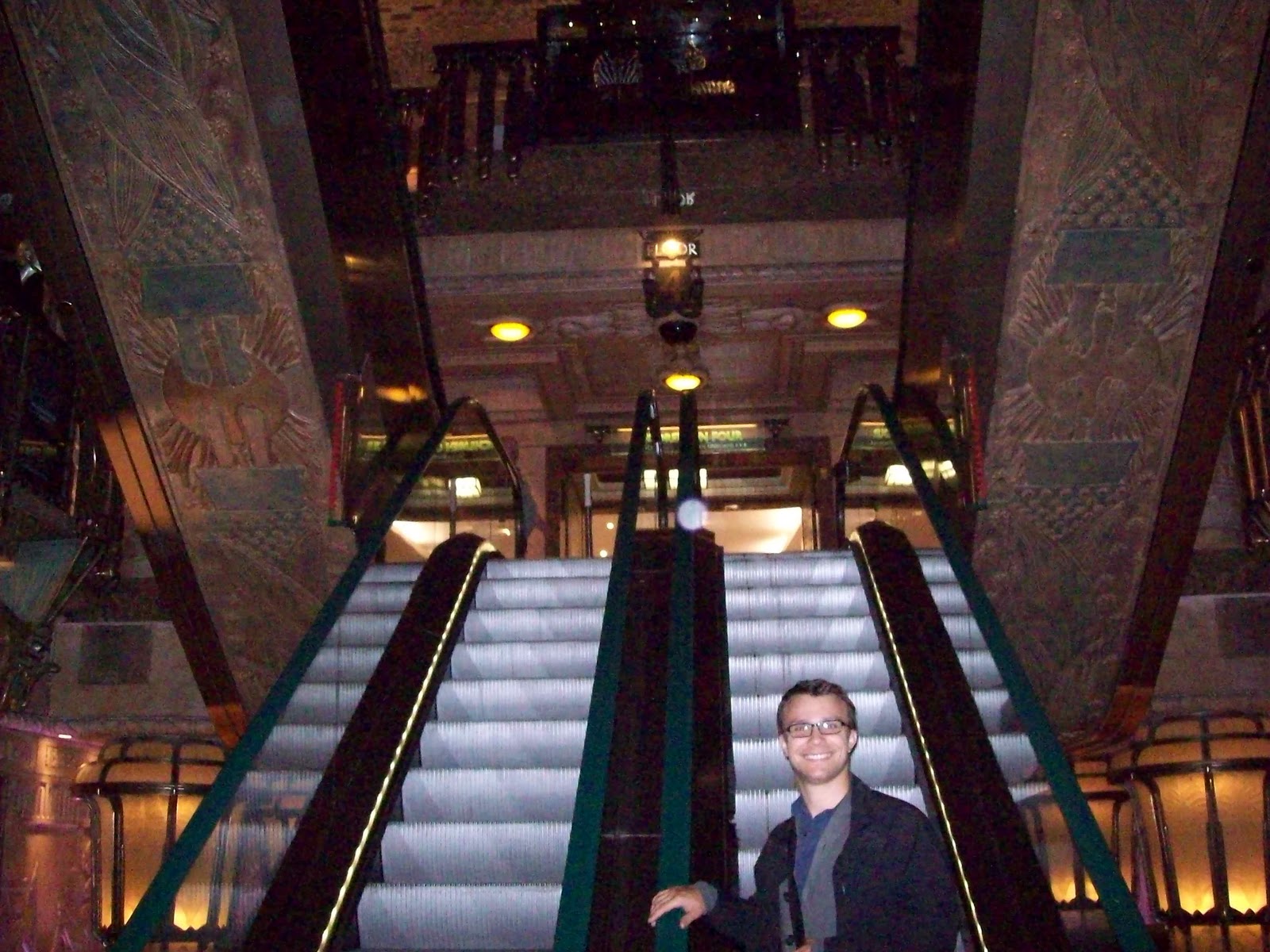
Lars on the elevator at Harrods

The above picture is the final picture from Harrods.  In the picture, there is a vibrant painted plaster design of the constellations, but I don't recognize much, so I'm not sure.  Does anyone know what this is?

The next picture was taken by Lars at the Natural History Museum.  There was a shocking exhibit about the effect of pollution and other networks such as utilities networks (water, electricity, waste water, fresh water networks, etc.) on the environment.   Since Lars works as a lawyer for utilities companies, he knows all about these issues and was so impressed to see an exhibit about it.

Acknowledgement is the first step to change.  I encourage everyone to reflect on the things your throw away, the energy you use and visit energy and waste control plants in order to understand the immensity of the systems that allow us to live a high-energy, take-it-to-go culture.   Plastic hasn't been around much more than a century and Tupperware was invented in the 50's or so, but already scientists are studying the "Great garbage patch" in the Pacific ocean and the "Dead Zone" in the Gulf of Mexico.  The pictures are shocking. (Not here-gotta go google.)


The next few pictures were taken from the Thames River  as we took a ferry ride from Kensington to London City and back.
Millennium Bride-pedestrian bridge with London Eye in background

The Globe from the Thames

The Gilden Hilde (More info below)
The above picture is of the Golden Hilde, a copy of the ship that Sir Francis Drake sailed around the world. 
London Tower Bridge

View of London south of the Thames

Tower of London (?) (north of Thames)

Tower of London

Guys Tower and Guys Hospital (under construction)
The tower in the picture above will be the tallest building in London, according to the Tour guide.
Big Ben aka Palace of Westminster

The London Eye and Westminster Palace

Westminster Palace (?)
The next few pictures were taken from Nottinghill when we went to the street market one day.  The picture below was taken in front of private residence.  I hope they don't get mad at me for taking a picture of their house!  If you know me, you know I love row houses!  I love the steps and the blue door here.

Unsanitary garbage disposal
Lars pointed out the unsanitary garbage on the street.  According to Lars, leaving garbage on the street would never be allowed in Germany.  This is because garbage on the street attracts vermin and other unfriendly visitors, who transmit disease.  My mom pointed out to me that maybe the sanitation employees were on strike.

Below is a picture of the Nottinghill street market.  Cars do drive down the street, but have to go slowly because there are so many pedestrians.  The cars driving along are mostly bringing in goods to the stores.  You can buy food, antiques, clothes and everything else at the market here.

The antiques were so awesome.  I love how the English love antique furniture too.  This is not really the case in Europe, I think.  Germans, at least, really like modular furniture, especially 70's style modern furniture from Sweden.

Antique appeal other than retro mod is just now coming back as a fashion trend in Germany and many call the style "Country Style."  It doesn't matter if it is baroque or rusted iron, it's all "country" in Germany.  According to a furniture saleswoman in Görlitz, this country style trend comes from Denmark, England and France, mostly.  This seemed curious to me, because I saw stuff that looked to be directly taken off the wall of a Cracker Barrell store.  Some items had faded English writing on it, like a sign that said, "Home Sweet Home", or something.   I told Lars that I think the country style imitates the American preference for used-looking furniture, quilts, etc., all that stuff you would expect at a Bed & Breakfast, I guess.  Is this a growing nostalgia for the past just like in the US?

But, I don't think many American companies are capitalizing on this.  A quilt can cost 200 euros in Germany, if you can find it.  There's so much demand!  Pastoral designs on curtains, sheets, etc. and classic iron-frame beds are so popular, it is immediately sold out.
Nottinghill Market
Kensington, where we stayed in a Hostel
The following pictures were taken mostly from Kensington, where we stayed.
Looking out from the balcony at our hostel.


Small-town London in Kensington


just another street market in Kensington


Fish stall

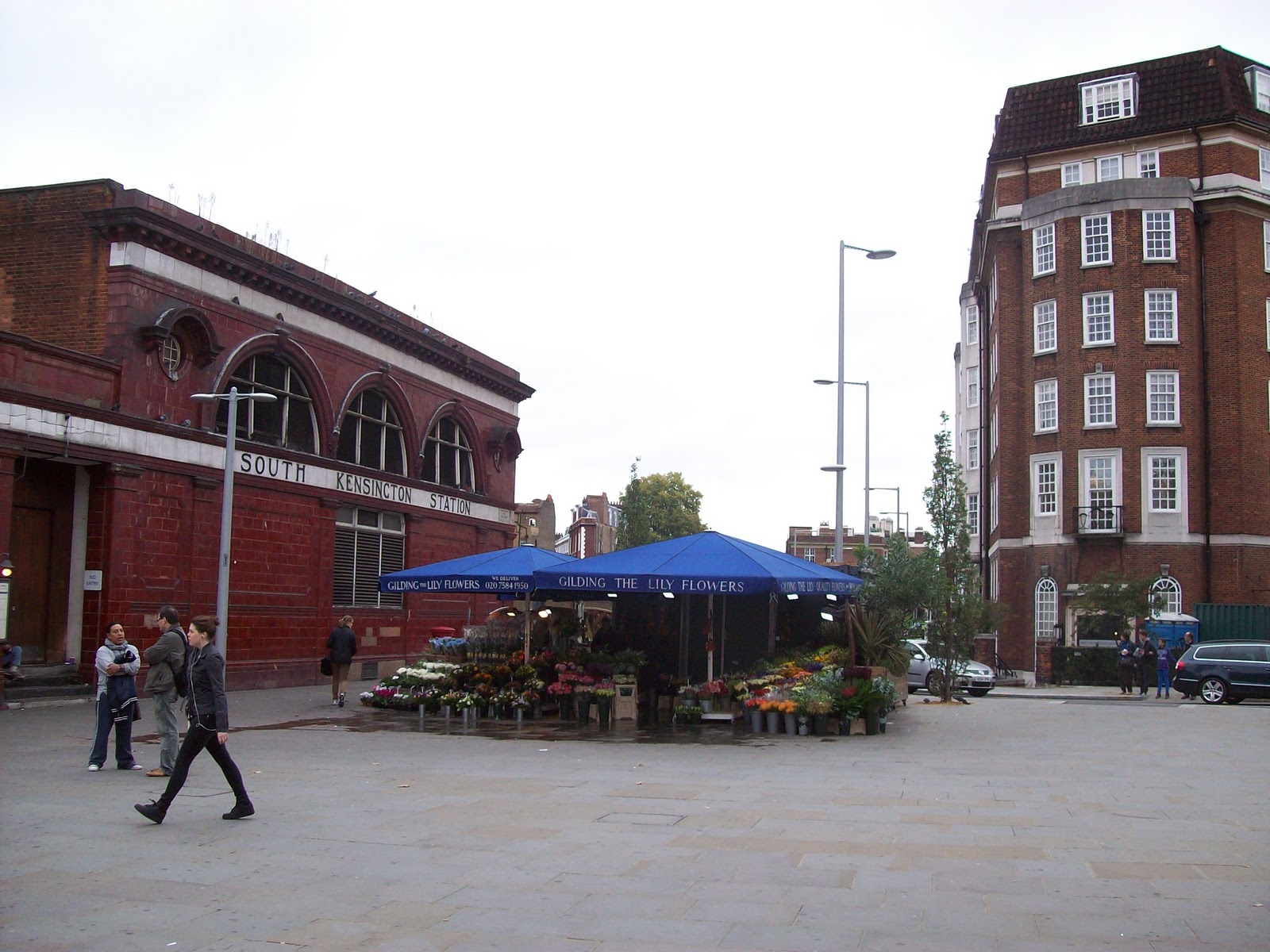
Flowers outside South Kensington Station


 They trademarked me!

Viktorian Michelin Store...what were victorian tires like?

Chelsea near the Spanish Embassy

Rent-a-Bike Stand

A market in Chelsea

The image speaks for itself.  
 The British may be conservative.  They may be polite and reserved.  But they are not afraid to use bright colors!  Example in point, the Belgravia Police Station flaunts its blue-purple rail with matching barbed wire.  How quaint.  I'm sure the inmates appreciate the color coordination when they first peak over the fence during an escape.  "Oww, barbed wire.  Oh, look, (in)mates, what a nice color!" Sorry, maybe a bad joke.
New development near Marks & Spencer in London City
 Sometimes new developments are not very popular, I guess.  We noticed this in front of the Marks & Spencers near London City (Londonium).  There was hardly anybody out on the sidewalks compared to other streets or ped-zones of London.

Below are pictures of the Globe, a copy of the original theater called the Globe.  Shakespeare's plays were originally performed here.  I didn't go inside though, because tickets were pricey.

The Globe

The Globe


The pictures below were taken off a side street on the south side of the Thames Bank near the Globe.   It was a real surprise to suddenly see the archeological/architectural remains of Winchester Palace around Clink street (see map below).  I found this interesting information about the palace on Wikipedia:


"Winchester Palace was a twelfth century palace, London residence of the Bishops of Winchester.It is located south of the River Thames in Southwark, near the medieval priory which today has become Southwark Cathedral.


Winchester Palace by Wenceslas Hollar, 1660.
Southwark was the largest town in the old diocese of Winchester and the bishop was a major landowner in the area. He was also a power in the land (Winchester being the old Saxon capital), and regularly needed to be in London on royal or administrative state business. For that purpose, Henry of Blois built the palace as his comfortable and high-status London residence.
The palace remained in use until the 17th century, when it was divided into tenements and warehouses, but was mostly destroyed by fire in 1814. Part of the great hall, and the west gable end with its rose window became more visible after a 19th century fire and 20th century redevelopment. It is believed that the great hall was built c.1136 and that the rose window was added 200 years later. The hall had a vaulted cellar below with direct access to the river wharf for bringing in wares, and was richly decorated. It often entertained royal visitors, including James I of Scotland on his wedding to Joan Beaufort (niece of the then bishop, Cardinal Henry Beaufort) in 1424.
The rest of the palace was arranged around two courtyards. It other buildings within the site included a prison, brewery and a butchers. The bishops also had access to a tennis court, bowling alley and a garden."


The Remains of Winchester Palace

Lars in front of the only remaining walls of Winchester Palace
Winchester Palace is straight ahead- (large round window at top left)


Just a little further down the street, we encountered the Golden Hinde (also on the map).  We checked out the boat for a while, then went south to the Borough Market.


Here I am standing in front of the Golden Hinde- a copy of Sir Francis Drake's ship


Looking up at her mast.

A view of the Golden Hinde


All Aboard!  Round the world we go.


Southwark Cathedral


Potty Parity

This short post is about a topic related to urban planning/land use.  Lars and I had a wonderful time in England, but there is one thing that really bugs me about England: waiting in the cue for the WC.

Are you laughing yet?  

This is Potty DISparity- something I hate about London: the above picture speaks for itself.  If you can't tell what is going on here, let me tell you: this is a picture of women standing in line for the toilets.  Also, if you can't tell, no men are waiting in line. 

The voice you hear is Lars saying, "Ist geil!" or "is funny," loosely translated, as I turned the video setting on.  Lars knows how much I abhor the queue for the washroom/restroom/WC/toilets or powder room, depending on your dialect.

I am not exaggerating; this is a real problem everywhere I went in England.   I can't tell you how annoying it is to stand in line for 15 minutes and watch 15 men or so walk by into the men's room giving you the pity smile.  They are thinking, "oh man, glad that isn't my line."  

Ever noticed that men never stand in line?

As a woman, I feel that I have two choices, I can either hate the women in the line because there are too many too many of us, or I can hate the men, because they don't have to wait.  What do you choose?  The correct answer is neither.  Someone else is responsible for this.   The planners, engineers and lawmakers are responsible.

Well, the US has improved a lot in this regard due to regulation and parity laws.  I talked to Brant, my stepfather, about this.  He works for the Florida Department of Transportation and told me that this issue is called, "potty parity."  The fact is that women need more toilets than men for various reasons.  It takes us longer to use the restroom because we have to do more than pull down a zipper.  It also takes longer because, for physiological reasons, we use the restroom more often. Apparently, incontinence and urinary tract infections are more common in women, confounded by menstruation, which partly explains this.   There are technical differences to the way men and women use restrooms too; women use the same stall for all uses whereas men have a streamlined separation of use system: urinals and toilets.  The result is, men need less time to use the restroom because of zippers and urinals, and need to go less often.  

There is a third factor and that is that the elderly need to use the restroom more often than the young for biological reasons again, and most older people are statistically female.  So, if you are a person, who needs to use the restroom, you are most likely going to be a woman, and you are going to need more time than the minority of men going to the bathroom.  This is why equal stalls for men and women is not fair.  Equal is not fair in this situation.  It is counter-intuitive, sure, but engineers can calculate what the ratio of toilet facilities should be for women and men.  

There's no shame in being a woman!  I feel insulted waiting in line.  Time standing in line is time wasted for me, and there is nothing I can do about it, even if I try not to drink at all, I'll never be a man, so I'll never get the fast line.  It was all planned this way. No one cares that me and the little old ladies are waiting in line and we really gotta pee!

Maybe I don't need to continue on this point, but here is a little factoid: the term "potty parity" became popular when a California lawyer, a man- by the way-, started a movement by saying that an equal number of toilets for men and women is not fair.  His motivation was not entirely selfless; he admits that he was tired of waiting on his wife while she waited in line to use the restroom.

Potty Parity article from the Washington Post

From Wikipedia

Regulations

Current laws in the United Kingdom require a 1:1 female–male ratio of restroom space in public buildings.The International Building Code requires a 2:1 female–male ratio of toilets. New York City Council passed a law in 2005 requiring this in all public buildings. An advisory ruling had been passed in 2003. U.S. state laws vary between 1:1, 3:2, and 2:1 ratios. The Uniform Plumbing Code specifies a 4:1 ratio in movie theaters.

Thursday, December 8, 2011

Urbanized Film

Check out this film about urbanized life around the world and the role of urban design in place.  Follow the link below to rent the movie.  I also appreciate you using my link because I get member benefits if you do so.

Urbanized Film to rent:

Tuesday, November 29, 2011

Daytrip to Goerlitz/Zgorzelec

Lars and I spent an afternoon in Goerlitz, a city in the region called Lusatia of former Silesia, in order to scout out antique furniture.  We had a pretty good time window shopping for antique furniture in the city, a lot of which is Art Nouveau, which is known as Jugendstil or "Youth Style" in German.  This type of architecture was popular at the turn of the 19th-20th century and incorporated organic shapes, lines and occasionally figures into its motifs.  The most famous city for Americans with a preserved and enormous amount of Art Nouveau buildings, furniture, houseware ist Prague.  Art Nouveau art and architecture was embodied by the Arts and Crafts Movement in the US and Great Britain.

The following pictures really highlight what a beautiful town Goerlitz is.  Many of the buildings are older than Art Nouveau and are medieval or baroque instead. Goerlitz is a Saxon city, as is Meissen, Dresden, Leipzig and Chemnitz (previously known as Karl-Marx-Stadt). There is a saying in Saxony, Germany:  In Chemnitz, one works in industry; in Leipzig, one makes a profit.  In Dresden, one spends the money (royal seat) and in Goerlitz, one can live comfortably in retirement.  Maybe this is why Lars refers to Goerlitz as a retirment city for all the rich.  The furniture we found was all very classy.

Here's a little bit of history: Goertliz was an important city in Silesia, before Silesia was almost entirely taken away from Germany after WWII, causing a mass exodus and human migration to other parts of Germany.  This is a very sad history, the effects of which are still felt in Goerlitz.  The border for the new Germany was the River Neisse, which runs through Goerlitz, thereby resulting in a split German-Polish city.  The polish side of town is called Zgorzelec.  Can a town be one if it has been split between two countries?  If you have an opinion on this, come and look at Goerlitz.  It is an interesting question.   Residents here refer to their city as an "international" city, and it truly is!  Maybe a more appropriate word would be "binational."


View looking out from a furniture store.

Medieval city tower in center  next to Art Nouveau row houses.

Massive church with gothic? windows?


Old Medieval streets and alleys are precious.

Lars is taking a break, already tired of shopping

Steps to old Town Hall?- Baroque or Neo?-Gothic

Cooking pumpkin, spelt breakfast roll and Poppyseed cake
This last picture is the odd picture in this post.  I took all these pictures in September, when Fall was just starting to set in.  I could feel the change in the seasons, but I could see the change in produce and local food being sold at markets, grocery stores, restaurants, cafes and bakeries.  The Poppyseed cake is a Autumn favorite because, apparently, poppyseed is a fall crop, just like pumpkin.  I didn't know this.  Spelt is called "Dinkel" in Germany, and is used to make a variety of bread items.  Here, it isn't back in vogue, because it was never was out of vogue.  I think food is culture too, and I wanted to share my food experiences as well.

The bread rolls are for breakfast and are eaten with cold cuts, cheese, Leberwurst, eggs, marmalade and meat salads.  Cakes are eaten at Vespars, or coffee time, around mid-afternoon, especially on weekends.   Pumpkin is popping up everywhere here, in soups, main dishes, and in vegetable medleys.

Fall is a wonderful time.  I like how the light seems a bit yellower.  Maybe that is just because the sun is going down sooner, creating longer shadows and creating the yellow-orange tint associated with dusk.

Tuesday, October 25, 2011

Modern Problems- Is it all just about the car? (edited)

 I have to edit this blog right now so that no one misunderstands my rant, which should have been proofread.  I actually really like Florida and the US, so I don't mean to be too negative or offend anyone.

The topic is: Where did all these modern problems come from?

I don't understand why we, people today, see sustainable living as something dependent on a technological revolution.  We consumed less energy and produced less waste a hundred years ago.  Certainly we have some of the solutions to the energy crisis already.  For example, air conditioning and don't need to be as prevalent as they are (in the US).  Food production could be more local, cutting down transportation costs and pollution.  Food production itself could be more environmentally friendly.   The list goes on and on.  The modern technology of the past 100 years has caused a lot of problems.  Why is technology the exclusive solution?  What if we have to go back, partly, to how we used to live?  Walk more, shop in your block, Travel using public transportation.  Pay more for food and more for your home.  Less packaging, because food doesn't haven't to travel the whole world for retail.  Take baskets and cloth bags shopping, just like people have for thousands of years.... It's not a new idea!

Let me give an example of how people are unaware of the effect that new technology has has on their own production of waste and pollution: the human north-to-south migration to naturally hot areas requires air conditioning.  Lots of people in Florida like to say, "I love the heat in Florida!"  I'm like, "Oh really?" I didn't have air conditioning in Philly because I didn't need it in an insulated town house. 

Those people tend to be the northern American immigrants, to be specific. I have to be specific because there are a lot of people in Florida from Vietnam or Puerto Ric, for example, and they don't really talk about how wonderful the heat is, because it's already normal.  

When hearing northerners talk about the wonderful heat in Florida, I'm thinking in my head is, "You don't like the heat at all.  You like air conditioning- is more like it- and now you have a reason to turn it on.  You don't know a thing about the heat in Florida."  None of us do, really, except for that horrible day when the electricity goes out because a hurricane blew a tree over the powerlines.  And maybe you're crying too because the gator ate your dog, Snuf. (For a scenario) But, when was the last Summer day  that you could bear to be outside all day, without rushing inside to "cool off", as they say or run away from alligators?  As far as I'm concerned, there is very little about Florida "heat" and weather that people like, so instead they hibernate inside all summer and most of the rest of the year, and travel around in air-conditioned cars otherwise.  There is nothing "green" about that.

As a side note, city-construction/city planning and architecture methods of previous centuries discovered ways to build buildings that creates a drought through the buildings.  Building height (more than just one story obviously) and awnings can also strategically be used to create shade from the sun.  Also, older Florida homes were built longways and parallel to the sea, in order to get the breeze from the ocean.

I have an anecdote to complement this topic: my mom, while visiting historic downtown Orlando, said more or less something like, "Wow, it's so breezy and shady.  It's so nice to be outside here. It's hard to believe it."

That is the problem, it's hard to believe that we already have all the answers we need for so many of our modern problems.  Only, they aren't necessarily all going to be new solutions; a lot of them will be what has been time-tested and true in terms of urban design.

I want to say, "We are too dependent on air conditioning!" These modern technologies have become a crutch for Florida living.  I am not particularly nostalgic, I just don't think that current energy usage can sustain the kind of Florida-lifestyle that is almost exclusively available now.
~~~~

But, there is another problem confronting urban design: where will we put the cars?

 It seems to me that our problem is just our mobility with the car.

I know, I know; I'm simplifying things too much.  It isn't just the car. But the car is at the bottom of a lot of our new, modern problems, which have been encouraged or exacerbated by car-living, car-design and the industries which strive to make it possible for the accompanying car-based infrastructure and economy.

Given, the trend began with the train; with its advent, people rushed out to settle new areas, resulting in lower population density in our cities and fueling a popularity of small-town living.  And, even before that, thinkers like Thomas Jefferson were already espousing city-life as decrepit and corrupt, dirty and unnatural.  I understand why they felt this way.  Most of those Americans were tired of London and idealized the simplicity of smaller towns.  But those smaller towns were in every way more urban than the car-designed small towns and suburbs we have today.  The older small towns, like Cottbus until 1945, were as dense as many modern walkable cities are today.  But, since the revolutions leading to car affordability, we are even more likely to live in low-density communities, which defy all historic precedent.

The evidence for this is on record: small towns and cities used to be dense.
Low-density is new.  Today, we have lots of new problems.  Therefore, low-density may be related to our modern problems.  Could it be a root cause?

Is low-density the  Problem? I mean, I just discussed air-conditioning, but maybe the car is the elephant in the room, so to speak.  No everyone wants to talk about their car usage and the participation in creating the hole in the ozone layer.  But, isn't that, like, the main cause of it?  Or a big cause of it?  I heard that Americans consume 30 percent of the petroleum supply (in the US) on personal automobile travel.  That compared to like five percent or something in Europe... and other countries don't manage to use that much at all.

We worry about a lot of things, and it might all be random and disconnected.  But, let's play the game of asking ourselves whether our modern problems could be caused or related to the isolation or social/economic structure of low-density living.

We have modern energy problems,  physical-health problems, modern mental-health problems, economic problems, a dependence on large corporations (for our employment and for the supply of products), food access and food quality, global warming, access to nature, etc, education, etc.

1. Physical-health problems? Obesity?  -- People used to use their legs for transportation.   This problem could be car related.

2. Mental-health problems?  Isolation? Lonliness? Are we left to learn what is right and wrong only from tv?  How many people today go into the gas station just for some human interaction?  In a dense environment, people walking on the street and shopping in their own neighborhood had a community.  In residential, car-friendly developments, businesses are against zoning ordinance and people jump in their car because walking talks too long.  No easy human interaction here.  Car-design could be the problem.

3. Economic problems?  Lars said to me once after looking at the US Department of State's fiscal budget pie chart, "Whoa! The US doesn't have a debt problem at all, just a Military problem"  He said that because the budget showed 30 percent allocations to the military, excluding police etc.  And, not to simplify things, but aren't we at least partly involved in the wars in the Middle East because we need peace in that area, or we'll have an energy collapse in supply?  And isn't the oil for cars mostly, and plastic secondly?  Maybe that is just gossip...

Besides the oil business higher density with proper mixed use design is good for business.  That is because we all know what our community needs, and business owners can react more quickly to local demands if they have a fighting chance to compete with chain stores.  Big box stores do better in surban settings than in dense settings... because there just isn't the space for a Wall-Mart type thing in a city.  If you don't know what I mean, go to a really dense city street in any big city, and you'll see all kinds of things.  The more the better, right?  Isn't that the free market?

~~~~~
Another thing, what if bad urban design strangles out the small-time business shop owner?  Malls are an option, but how natural is a mall?  The whole issue is super complex I think, but my feeling is that malls aren't flexible enough because they can't really shrink or grow with the demand for space.  And, you always have to problem of inconvenience.

In a dense neighborhood (it doesn't have to be in a city) we would have an even stronger feeling of what residents in our town need.  We could be the one to supply it.   We would know, because we would sort of see our neighbors more if we traveled less by car and interacted with our neighbors more, in a mixed use designed/permitted neighborhood.

If Zoning and real estate prices make it unattractive or impossible to open a business in our neighborhood, then less people can open their own businesses.  Big Box is the easy solution. The economy is then dominated by MBA's who run big stores and think in numbers and have no relationship with us.

Do you ever feel like there is nothing personal about shopping anymore?  If all we have is those big box stores or shopping malls with comercial chains run out of NYC or wherever, then this is a sad sort of modern world.  It is similar to the stories I have heard about communism in East Germany and Poland.  Except it's worse.  The stores decide what to put on the shelves based on "market studies", but it is impossible for us to meet our own communities demands.  We are just a number, a consumer.  This is not the nice-communism that makes sure we all have health insurance, for example, and some type of employment, haha, but something else, something unintentional.  This is a big issue, and I couldn't begin to argue about this without some additional/concrete facts... but maybe I'm on to something.  I'm sure I'm not the first person to think of this.

Another issue is insurance and healthcare.  Those big insurance companies don't care about you, even if the individuals who work there might want to care about you; they have no time to do so.  They are stressed out, don't see a face.  And the lawyers, they profit on the problem (but most not that much), and can you blame them?  Besides, there's a new trend of turning law offices into corporations, where even the lawyers get abused, and who can they complain to if the whole system works that way?   They're under pressure to take on more and more and more cases.  It all comes down to economics, which is somehow related to how we run our communities...

A good way to counter all these new modern problems is to focus on phsyically creating/allowing small walkable neighborhoods where we interact on a personal basis and shelter ourselves a bit form the cold, impersonal modern world.  I think it is necessary to build higher density, walkable towns and cities.

I know this seems too simple.  Experts, politicians, engineers, lawyers: they should all be concentrating on making a simple solution possible: How can we live without the car.  We don't need more complicated answers and solutions.  We need communities; we need to care about each other in a personal way.  I think the reason we sense something amiss is because something is amiss.  Our basic instincts tell us this.  As they say, "Keep it simple, silly."  The car is a problem.  It starts with the car, leads to car-based design, and a whole domino effect follows.

The Baby-Boomer generation especially thinks of higher density living as stressful, but what if you took the car out of the equation?  Are they just stressed out about traffic? Cities can be denser, but density doesn't equal traffic jam.  Traffic jams only occur with cars!!! Lots of people on foot can be hectic, but you are still moving!  If traffic is caused just by moving about the city, then planners have already failed.  Traffic is often about getting out of the city.  But if you live in the city, you don't have to leave it and sit in traffic.

Thoughts on Food Deserts

When I worked on the Activity and Food Landscape Project at Penn (August 2010-October 2010), I learned a lot about the "Food Desert." It is a very very complex issue with interesting causes, terrible and surprising results and innovative solutions.  One cause of the food desert is that grocery store chains deem inner city neighborhoods of a certain demographic as "too risky", so they don't open shop, even though there are people this is the demographic, which tends to travel the most on foot or with public transportation, and traveling to a far away grocery store is an all afternoon affair.

But it isn't just inner-city neighborhoods.  The high-end, yuppy neighborhood I lived in in Orlando (which I like, by the way) has been the antithesis of a blighted inner-city for at least a decade, yet hadn't had a grocery store in a square mile radius for, like, 30-40 years!!  It was impossible to live downtown without a car, but a compact downtown isn't possible if everybody has a car, so the whole venture was doomed, until Publix opened a grocery store on Central and Eola Dr..

Also,  I know this because I lived in a food desert in Philly.  I lived a couple of streets away from a poorer part of town, but my neighborhood was all college students (no cars) and professors.  Corporations can be really blind sometimes when it comes to knowing where to invest.  I took me a half an hour usually to take the bus to the nearest grocery store, that or I had to walk two miles or so, also taking a half an hour.  My solution: I bought a backpack with wheels!  Two miles doesn't seem like a lot to some car-driving executive, but without a car it's a long way.  At least the walking was nice and I could walk down a recreational trail on the river on my way to the grocery store.  I guess I was privileged.

A surprising solution to the food desert problem is that the residents in these areas supply their own services for their own demand, and the result is a very non-corporate America in it's most authentic form, in my opinion.  There are parts of America that McDonalds, Wallmart's, and big chains don't care about a bit, so they don't open shop.  Access to fresh food suppliers for small scale and corner stores must be difficult though and could explain why lots of food-stores in inner-cities don't have good quality food, or if they do, it can be expensive compared to the chains.  At least a local resident had the pride of being his/her own boss.  

I mean, it is not as if all grocery stores need a pharmacy, bakery, meat counter and wine store within it; That is potentially six different stores, potentially run by six different small business owners.  The grocery stores might have to be smaller, but if there are lots of small stores, it comes out to the same amount, just spread out between a lot of hands, a lot of entrepreneurs.

But what do I know; I'm no entrepreneur or small business owner.  Or is this common sense?

Another solution are food markets on the weekend (from local farmers or imported, whatever), food trucks, and smaller grocery stores spread out more often (like every corner, darn it!).  Suddenly there are a whole lot of people in Generation X and Y, who want to have a farm, raise cows and churn out organic cheese.  That, or small family farms might have an alternative to selling en masse to some retailer. 

New Apartment, Same Town

Lars and I recently moved into our new apartment.  We now live practically in the town square, in the center of town life. 

Lars is my hero.  He found our apartment while I was visiting Agata in Poland.  Before my trip, we looked everywhere, but were faced with few options.  We saw an apartment in a Plate Development (with even a higher rent, but same space) in the south of the city, which seemed to be our only alternative to the loud apartment we had then.  Without a car, I would have been stranded after 7 PM in the Plate Development, when the last trolley serviced our area.  Our problem with finding an apartment was that we only want to rent short-term and we have a dog.  This time of year, with students going back to school, there's nothing left at all.

Miraculously, Lars found a two-room plus kitchen apartment for a lower price than even the Plate Apartment, and in the Old-City!  When I got back from Poland, he showed it to me and we moved in immediately.  Apparently, it was all luck; the last owner had just moved out.  Lars was the first person to commit to the apartment.  So, finally, Lars and I can say that we are settled in Cottbus, at least for the next 3-6 months!
Above is the view from the Foyet looking into the bedroom on the right and living room on the right.
Below are two pictures looking out of the bedroom window.  In the first picture, one can see a mixture of older buildings, Gründerzeit buildings and Plate-buildings.  In the second picture, you can see a  "Gründerzeit"building on the left, otherwise known as "Jugendstil" or in English, Art Nouveau style, a style connected to the American Arts and Crafts movement for its emphasis on organic and human form and decoration.  To the right is a building, similar to the own we live in, of Plate construction, or "Plattenbau."  A lot of the Old-City looks like the Plate building.

I learned that the reason for this is that much of the Old-City was destroyed during a bomb raid from the American-allies during WWII.  Since then, really nothing had been rebuilt until the Wall came down in 1989.  At that time, the town planners took a very conservative approach to rebuilding the Old-City: the decided to recycle the Plate-material they had on hand, but, instead of building large Plate building common to East European, they built building that fitted into the local buiding style and tradition.  That is why the Plate-buidling across the street doesn't really look like a communist Plate-building, even though the material is the same. 

Look to the Town Center "Alt-Markt", or Old-Market
View out my window, looking down a side street.  Plate-Building on the right.


Former site of City-Wall
Above is a interesting picture of the site of the historic City-Wall.  The stones mark the spot.  To take the picture, I stood in the middle of the street and looked south.  The street is also historic and was a main access into the city until 1500.  After 1500, the area around the wall became more settled, and I'm not sure what purpose the wall served then.  Still, the wall marks the boundary of the town until industrialization and the coming of the railway system, which caused an increase in wealth and an expansion of the city in all directions, especially southward.

I have been learning all of this in a class at the university, in which I get to look at really old maps of Cottbus and have to redraw maps.  One map I made shows the settlement pattern of Cottbus.  The city stayed the same size from its settlement in the 3. or 4. century AD. (according to wikipedia) until industrialization, and then again after WW2.  So, in the last 150 years, the city has exploded in size!  By looking at the maps, I'm guessing that one could fit 12 Old-City size Cottbuses into the current Cottbus.  Basically, there was an exposion of growth with the advent of the railroad, and again with the arrival of the personal car.  Does that also count as urban sprawl.....?


City Gate and entrance to the left and house built into the old City-Wall

House built into the City-Wall
Old City-Guard station on the wall.

Market street leading toward the Alt-Markt. My apartment is further down on the left.


Above is the Plate-building I live in, designed to fit into the local building style.  The entrance to my apartment building is on the right.  Number 12, Marktstraße.